
Politics in Hostile Times
Author: James Patterson
Date: February 10, 2026
Editors’ Note: This essay is published as a work of political theory and opinion. The arguments and conclusions expressed are solely those of the author and do not reflect the views of the editors, the Amherst Political Review, or Amherst College. We publish this piece to invite critical engagement with its claims, not to affirm or promote them. The purpose of publication is to foster rigorous debate and reflection on contested political ideas.
“…I am.”
On December 12th , 2025, a contributor for The Washington Free Beacon, and fellow student, Jeb Allen, wrote an article on Amherst College’s administration’s push for sexual openness. Allen expressed contempt for the way the administration has handled the topic of sex, suggesting that the college is enforcing sexually degenerate beliefs on its students. His article has resulted in national coverage amid today’s politically toxic media cycle, while also stirring up the passions of Amherst College students. In response to Allen’s article, commentary was varied, from affirming Allen’s view that Amherst College has devolved into degeneracy, while those opposed to the article state that it doesn’t matter, considering that the students are adults. These discussions, though, have been a distraction from what lurks within the article: of what’s truly concerning not only Allen’s words, but what it reveals about the nature of politics . Allen’s article is symptomatic of political conditions across the country, where exclusion as belonging has not only mediated conversation but is the conversation. Today, politics isn’t a matter of just “us”, but also about “them.” Though, when I say “Today”, I really mean that the current moment we are experiencing is a matter of excess: we can no longer be ignorant to it. The hostile politics that Allen is pushing isn’t a result of some parasitic infection that has thrown our conditions into persistent conflict, but rather that Allen’s article represents an event a part of the pathology of what it means to live in a political order. This is to say that the politics of “us” against “them” is the axiom of politics. It’s not that Allen is practicing hostile politics; it’s that Allen is doing politics. Those who believe his views to be deplorable, as I do, cannot, nor should not, deny this reality. Though this doesn’t mean that others like Allen deserve to be on the winning side of this endeavor.
Allen starts the article with an appeal to Christian authority, citing that the college was instituted to prepare young men for the ministry. He contrasts this with the college today as a “hotbed of administratively sanctioned sex performances and ‘sexual skills’…” oriented around LGBTQ students and free-sex practices such as ‘polyamory.’ He describes this shift as “graphic,” which makes students “deeply uncomfortable.” Immediately, Jeb situates the college’s current administration in relation to tradition rather than speaking to the unethical nature of the college’s actions on its own. This move establishes a sense of nostalgia, situating the conversation as a matter of “devolving” rather than simply “this thing is bad and here’s why.” This signals readers early on for a need to return to form. Many uprisings in conservative popularity post-Civil Rights era, specifically the neo-conservative rise from Nixon to Regan, as well as the Make America Great Again (MAGA) movement, used this language of a return to form, in the former case, calls for a “return” to law and order, and in the latter case, the slogan is based on its belief in a past America as the ideal. Allen has established an apparent norm for the college based on the past, as the MAGA movement established a norm for America, that it is Christian, and any deviation from this is not only bad but dangerous. Here, Allen established the system of belief that is legitimate, and thus anyone who believes in and represents it is legitimate as well. This then leaves anyone outside of the parameters of this system as delegitimate: wrong. It is those who are legitimate (us) against those who aren’t and thus should be excluded (them).
Allen uses Amherst College’s “Voices of the Class,” a performance for the incoming freshmen during their orientation, as the initial example of this deviation from norms. Though it’s more of an offense: the catalyst. Allen provides videos and images that depict the stage actors mimicking sexual scenes, such as fellatio, masturbation, and orgasms. Within the background of the first video, a concerned “what the fuck” tinged with disgust can be heard as the laughter from the rest of the students in Johnson Chapel drowns it out. Emphasizing the importance of the Chapel, Allen again appeals to authority, this time in the form of historical figures as symbols. He mentions the presence of the portraits of “the most notable figures and alumni,” which include all previous presidents of the college, civil rights leaders, Calvin Coolidge, Emily Dickinson, etc., all of whom would’ve “likely…looked on in horror of the event.” Allen, in admitting his assumptions about the private beliefs that these figures held on sex, repurposes them from historical figures into symbols of what the college is and ought to be. Allen uses them not as they are but for something else: tradition.
The “what the fuck?” is the call of tradition, a call drowned out by the static dial tone laughter echoing in what Allen believes is now the shell of Amherst College as a symbol of Christian tradition. Amherst College has been hollowed out; the current and most recent administrations of Amherst College are the culprits.
The Voices of Amherst performance, for Allen, comes at the end of a long line of school-sanctioned events within the realm of sex positivity. Allen makes mention of a variety of other program/events in this realm: mandatory wellbeing skits (“which depict students roleplaying various casual and drunken sexual scenarios, including sex with strangers); Sex in the dark (“taking place in the darkness, students are encouraged to speak about uncomfortable sexual topics, such as their sexual orientation, habits, kinks, and fantasies with the ‘sex experts’…”); and Beyond Monogamy (where “…students were encouraged to speak with three licensed therapists who ‘specialize in polyamory and ethical non-monogamy’ about ‘building healthy non-monogamous relationships in college and beyond.’”). Allen also speaks on how Amherst’s queer resource center teaches students different types of “healthy non-monogamous relationships” where he names, but does not define, open relationships, relationship anarchy (, polyfidelity, etc. He then speaks about the annual drag show, and the inclusion of rapper “Cupcake,” who performed songs like “spoiled milk titties,” “juicy coochie,” “Deepthroat,” etc.
For Allen and many others who share his worries, what is transpiring at Amherst College shouldn’t be taken lightly. These events don’t just disturb the norm of Amherst College but erode it. As is implied through his interviews with Amherst College students, this erosion isn’t amoral. One interviewee, Isabella Niemi, stated that the administrators not accepting feedback on the sexual performance, an event that Allen states students were both forced yet urged to attend, was them avoiding feedback because they didn’t want to be told that the performance wasn’t normal, or useful, or funny.” This notion of not being “normal” is harked upon later with student Evana Toumazatos, seeming to affirm Allen’s opinion on affirming “sexual outsiders” and norm-breaking sexual behaviors as bad specifically in reference to the queer programs and drag shows, saying that “it just feels so disturbing and dystopian.”
While the article is certainly about sex, one should not get caught in this web so easily. It’s in Allen’s appeals to Christian tradition as authority, the repurposing of historical figures, and the language of “sexual outsiders” and “norm-breaking sexual behaviors” that what Allen has developed in this piece is a matter of culture war journalism designed to situate an us-against-them mentality. Allen has used sex as a Trojan horse for his politics of exclusion. However, it’s not a politics of exclusion simply, but a politics of exclusion as belonging. Allen ends the article with another quote from Niemi: “If I knew how constantly repressed, bad, and weird I would feel for not partaking in campus culture, I would have thought a lot longer about coming to Amherst. …It takes a huge toll on you, constantly hiding your opinions from students and professors all the time.” This quote reveals that the beating heart of this us against them mentality is a fear of alienation amidst one’s community. It’s in the sexual “outsiders” and their norm-breaking that has brought on this alienation: this “dystopian” condition. It is they, them, who have brought this condition upon us.
But who is “us?”
“I am your warrior. I am your justice. And for those who have been wronged and betrayed, I am your retribution!” As referenced in an article by News Lines Magazine, this quote, spoken by Trump in a spring 2023 rally, establishes what it means to be political in a hostile time. As the article mentions, when the New York Times interviewed a Nebraskan farmer, he stated that Trump’s accession into office was the first time he felt a sense of belonging in the United States: “Trump made him feel that he was part of something larger, something noble and exalted.” The MAGA movement is characterized by this deep sense of alienation that Trump has taken and turned into populist fervor. Populism is centered around a mainchain outlook: good and bad. Those who are good are a part of the in-group, and those who are bad are a part of the out-group. Within the MAGA movement, the in-group is “real-Americans” while the out-group is simply the negation of this. This doesn’t just mean anyone not born in America, but those who embody un-Americanness. Those who are “outsiders” or “norm-breakers.” This norm, as suggested by the slogan Make America Great Again, does the same thing as Allen’s article, which is to situate the wrongness of today’s world as compared to the greatness of the past. The MAGA movement is an appeal to authority as tradition. Though, this authority is never fully articulated, unlike Allen’s piece. This, again, is what makes the MAGA movement so powerful in that it takes a country with a past as vast as it is and says, “Let’s go there!” Everyone thinks they have an idea, and they act in accordance with it without knowing what “it” is. So, then, this “us” can shift, but, and especially so, the “them” can as well. The “them” can be anything. It can be the gays, trans, blacks, “illegals”, radical left, “woke,” etc.
A negation isn’t substantive, as it is never for itself. However, when that negation, “them,” becomes an extension of the substantive, “us,” then the MAGA movement must sustain the thing it sees as a scourge on its sense of belonging. MAGA must maintain the outsider, and people like Allen must sustain their dystopia. This is the price of exclusionary politics based on supremacy. This is the price of exclusionary politics. This is the price of politics.
What makes exclusionary politics so dangerous is that it requires an “other.” Exclusion based on supremacy is a matter of order. The supremacist of any kind must have an other to maintain their own supremacy; the liberationist needs only for the other to be gone to flourish. This isn’t inherently a good thing. The supremacist exclusionist maintains suffering. What MAGA wants isn’t a country absent of the other, but an other that is controlled. What Allen wants isn’t merely an Amherst College that is “normal”, but one where the norm is enforced and any “sexual-outsider” is punished. Punishment isn’t a means to an end, but is an end in it of itself. In this way, exclusion is merely conditional mediation.
This maintenance of the other is political energy that cannot, and must not, be diminished. While this requires a degree of the outsider’s lifestyle to continue, it’s only to the degree to satisfy the need to feel supreme. This is what it means to have politics in a hostile time. There is no debate when the question on the table is whether or not you belong. What the students at Amherst College and those opposed to the MAGA movement must face is that what’s happening is a conversation of who belongs and who doesn’t. Talks of purely inclusion are not only insufficient but also hostile to your well-being when the people you want to include don’t want you. Or, in wanting you, want you for ends which deplete you.
As I see it, exclusion as supremacy is of the kind Allen and MAGA are practicing. By this, I mean that to be supreme over someone is to admit that you’ve taken up a moniker where their existence is required for you to feel good. Supremacy, in this way, is self-captivity. Supremacy is for something, but only insofar as it’s for something else. We ought to liberate, for it not only frees the “other” from the oppressor, but frees the oppressor from themselves: from the need to oppress. But liberation is not politics. We are not in those times. We are dealing with the supremacists. We are dealing with politics.
At the heart of politics, the question is: who does and does not belong? The political is possible only where people are. This seems simple enough, but when it comes to establishing the ideals (the spirit) of your community, and from this the principles and rules that guide and coerce this community, it is the body (the singular body/individual) that determines those ideals. This means that ideals, being abstract, are tied to the material. The political isn’t a matter of simply ideas. It’s not so that there is a perfect world beyond us that we extrapolate from (with a perfect idea of politics, state, and law as Plato posits in his theory of forms) as we are left with its deviations, but that it’s within the imperfect that we can posit about the perfect (the ideal). We see what is, and we posit about what can be – what ought to be.
The material gives way to the ideal/spirit of the community. Thus, the political is material as spirit. The political is in the white picket fences of a suburban dream, the gothic architecture of high-strung academia, the heckling and belting of cheering fans in America’s pastime, Gun shows advertised on billboards, dead children in a school hallway, Friday night lights, raging homophobia amidst hyper masculine jocks, your local mom and pop shops, decaying small towns, sky scrapers within bustling metropolises, their deserted dark alleys, an ever expansive culture produced by a Hollywood wanting to depict a diversity ever emergent, and the white working class underbelly consuming it through the screen after another shift and before the next one. The people are the spirit. People are spirit. Allow me to paint a picture…
Who are the people? Floating amidst this air, through me, around me, and within those I love, what is this spirit? Insofar as it animates me, it’s me. Yet, so too does it animate that criminal, that thug. They get shows illustrating their side of the story – “empathy”, they call it. But what about me? They take and take, and now I see them where I should be seen? No. This can’t be. It won’t be. How dare you forget me? When I look upon this spirit, I should only see me.
There is a real anxiety in realizing that you are no longer the essence of the community in which you emerged that your life is outmoded and eroded by the people around you. How scary. How lonely. Indeed, there is nothing scarier than realizing that not only has your community rejected you, but that it has rejected the concept of you (you as a type of person). You can, of course, regain access to the community, be a part of its essence, but only insofar as you are not you. You must negate yourself, become something else. Change your beliefs. But if it is true that what you believe is the connective tissue of your identity, then to change these amounts to mutilation of the self: the spiritual self. Of what community should I be apart of that ask me to do such a thing? Either I get rid of those who have taken the community away from me, or I destroy the community.
This is the fear of what lies at the center of MAGA supporters. Not anger, not rebellion, but isolation. It’s what lies at the center of Isebella Niemi’s quote: “If I knew how constantly repressed, bad, and weird I would feel for not partaking in campus culture, I would have thought a lot longer about coming to Amherst. …It takes a huge toll on you, constantly hiding your opinions from students and professors all the time.” No wonder there is outrage. How can these “sexual outsiders” take over?
It’s a scary thing to realize that you’re at the fringe.
However, I don’t care.
That’s the game. That’s politics.
For them to be included means that I won’t. For them to “be” means that I can’t. This is politics in hostile times. But only insofar as these hostile times give way to politics in stasis. Slavery didn’t get abolished through an amendment; it was through bloodshed, through war. Politics in these times is deciding who belongs. Belonging isn’t purely substantive: for itself. The word implies that there is a thing that doesn’t belong. Belonging is a negation of that which doesn’t deserve to be there. Jeb Allen understands this, and MAGA understands this. I know this, and you ought to understand it. It’s either them or me. And I choose me.
I abhor this fact. We ought to talk, to converse, to speak. But when a knife is at your throat, and there is no one around to save you, to whom will you plead?
So, in this way, what Allen has done is an effective political strategy. It gets at what is wanted, what is desired. So we must do the same. We must laugh harder in Johnson Chapel, drown them out in the static dial tone that is our desire. It’s not enough to say that someone like Allen is wrong; we must say that he does not belong. This isn’t making a descriptive statement, but instead a normative one: Allen ought not to belong to Amherst College. The same goes for the MAGA movement: it would be incorrect to say that MAGA isn’t American, but they ought not to be American. If we want to survive, we must exclude those who don’t want us there. Laugh harder.
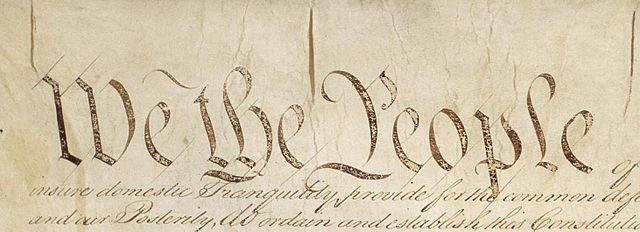
“We the people of the United States, in order to form a more perfect union, establish justice, insure domestic tranquility, provide for the common defense, promote the general Welfare, and secure the Blessings of Liberty to ourselves and our Posterity, do ordain and establish this Constitution for the United States of America…”
And so states the preamble of the Constitution of the United States, the mechanism, the spirit, of a country free and plentiful. As plentiful as the land upon which it governs, and as diverse as the ideas from whence it emerged. But before establishing justice, before ensuring domestic tranquility, before providing general welfare, and before the tenets which decide what is right or wrong, constitutional or not, there are people. “We the people…” but who is “we’’?…
I am.
___________________________________________
About the Author:
James Patterson is a junior currently studying abroad at Oxford University. He majors in English, and Law Jurisprudence and Social Thought. You can reach him at jpatterson27@amherst.edu
 Amherst Political Review

Leave a comment